Introduction:
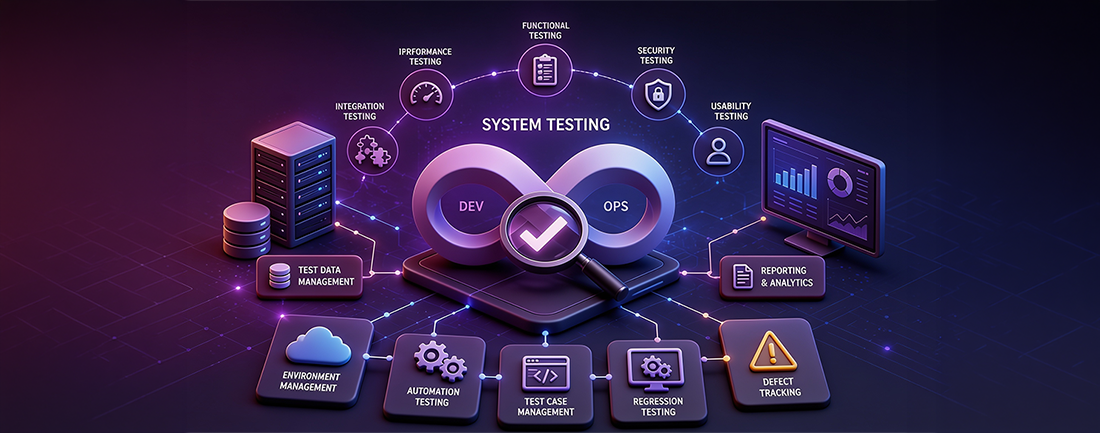
System testing is an essential phase in the software development lifecycle, ensuring that the entire system functions as intended and meets the specified requirements. However, this phase comes with its fair share of challenges and pain points that software development teams must address to deliver high-quality, reliable software products. Let's delve deeper into these challenges:
Challenges & Pain Points:
System testing phase comes with its fair share of challenges and pain points that software development teams must address to deliver high-quality, reliable software products. Let's delve deeper into these challenges:
Complexity of Modern Software Systems:
In today's technology landscape, software systems are becoming increasingly complex, with numerous interdependencies between components. This complexity escalates testing efforts as it requires thorough testing of each component and their interactions to ensure the system functions seamlessly.
Data Management Challenges:
Handling large datasets is crucial for testing realistic scenarios, especially in systems that deal with vast amounts of data. Moreover, ensuring compliance with privacy laws and regulations adds another layer of complexity, necessitating careful handling and anonymization of sensitive data. Documentation and Reporting Burdens: Comprehensive documentation and reporting are vital for tracking testing progress, identifying issues, and ensuring accountability. However, maintaining detailed documentation and generating comprehensive reports can be time-consuming tasks, requiring proper procedures and efficient tools for management.
Environment Replication Difficulty:
Replicating production environments accurately for testing purposes is essential to identify potential issues before deployment. However, replicating complex production environments poses challenges, such as ensuring consistency across environments and overcoming time-consuming replication processes.
Resource Limitations:
Testing often faces resource constraints, including time, budget, and available infrastructure. Dealing with limited resources requires prioritization and careful allocation to balance coverage and quality effectively within these constraints.
Regression Testing Complexity:
Regression testing ensures that changes to the system do not introduce new defects or disrupt existing functionality. However, managing regression test suites, especially in large systems, can be daunting, requiring effective strategies to maintain and execute tests efficiently while ensuring thorough coverage.
Error-Handling and Recovery Testing:
Testing error-handling and recovery processes is critical for ensuring system reliability and resilience in the face of failures. Identifying potential failure scenarios and validating recovery methods requires thorough testing and simulation of various failure scenarios. Addressing these challenges requires a combination of effective strategies, collaboration among stakeholders, and leveraging suitable tools and technologies to streamline testing processes and deliver high-quality software products.
FireFlink as a Solution to address System Testing challengess:
These solutions seem to tackle some of the key challenges and pain points in system testing, offering innovative approaches to enhance efficiency, effectiveness, and ease of use. Let's delve into each solution:
Data-Driven Methodology for Test Data Updates:
By adopting a data-driven methodology, updates to test data can be seamlessly managed within the Test Data session, ensuring immediate reflection in related scripts. This approach streamlines the process of updating test data, enhancing agility and reducing the risk of inconsistencies between test data and scripts.
NLP-Based Automation for System Testing Scripting:
Leveraging natural language processing (NLP) for scripting empowers manual test engineers to write scripts without complex programming knowledge. This not only increases testing efficiency but also lowers the barrier to entry for script development, enabling quicker adaptation to changing requirements and accelerating the overall testing process. Automation of Test Data Feeding with FireFlink: FireFlink's data provider features automate the feeding of various data inputs into test scripts, eliminating manual effort and streamlining test data management. This automation ensures thorough test coverage without redundancy, enhancing the reliability and effectiveness of system testing.
PDF Reporting with FireFlink:
Generating PDF reports with FireFlink facilitates easier reporting of system testing results, including script outcomes. This feature enables quick dissemination of test results, aiding in rapid issue resolution and informed deployment decisions, ultimately improving the efficiency and effectiveness of the testing process.
Suite Creation and Execution with FireFlink:
FireFlink's suite creation and execution features simplify the process of organizing and running tests. The "Execution" feature allows for the creation of various types of suites by adding developed scripts, while the scheduler functionality enables effective execution across multiple platforms or settings, enhancing test coverage and efficiency. Efficient Script Failure Examination with Auto Mark Feature: The patented "auto mark" feature in FireFlink significantly reduces the time required to examine script failures, improving the efficiency of issue resolution. By enabling quick and easy analysis of unsuccessful scripts, this feature enhances the overall effectiveness of the testing process, allowing for faster identification and resolution of issues.
Trends: Software Testing – System Testing
1. Automation in System Testing:
Adoption of test automation tools and frameworks to streamline processes. Increased test coverage and efficiency through automation. Continual trend towards leveraging automation for testing tasks.
2. AI and Machine Learning Integration:
Utilization of AI and machine learning for test case generation. Application of predictive analytics and anomaly detection in testing. Intelligent test automation powered by AI and machine learning technologies.
3. Focus on Security Testing:
Rising importance of security testing due to increased cyber threats and data breaches. Identification and mitigation of security vulnerabilities in systems. Integration of security testing into system testing processes.
4. Cloud-Based Testing Solutions:
Benefits of scalability, flexibility, and cost-effectiveness offered by cloud computing. Migration of system testing to the cloud for on-demand provisioning of test infrastructure. Parallel execution of tests and collaboration among distributed teams facilitated by cloud-based solutions.
5. Shift towards Agile and Agile Testing:
Wide adoption of Agile methodologies in software development. Evolution of system testing practices to align with Agile principles. Emphasis on iterative development, collaboration, and continuous improvement in Agile testing.
6. User-Centric Testing Approaches:
Growing emphasis on understanding user needs, preferences, and behaviors. Designing tests that simulate real-world usage scenarios.Integration of user-centric testing approaches to enhance system testing effectiveness.
FireFlink Suite Report
TestNG Framework Suite Report FireFlink Suite Report Customization isn't feasible. The FireFlink Suite Report offers customization options. Visual enhancements are lacking. Reports can be generated with geographical representation capabilities. Analysis proves challenging. The analysis process is straightforward
AUTOMATION-MANUAL TEST CASES
Mapping Manual Test Cases to Automation Scripts:
-
Clear mapping is displayed in the Tree Structure View of Modules.
-
Automation scripts linked directly to their corresponding manual test cases.
-
Ensures visibility and traceability of automation coverage for each manual test case.
-
Identification of Missing Automation Scripts:
-
Easy identification of manual test cases lacking associated automation scripts.
-
Enables efficient tracking and resolution of gaps in automation coverage.
-
Facilitates prioritization for script development based on manual test case coverage. Success Story of how Fireflink handled Automation for a large Financial Services Client
Client Background
A client in the financial services industry provides payment services to e-commerce and retailers. They help their users complete payments using multiple payment gateways, and provide a one-click checkout experience to their customers.
DOMAIN: Financial Services
Challenges
- Integration of Web and API Test Scenarios
- Need to automate web and API test scenarios within a single script for end-to-end payment validation.
- Complexity due to dependency on inter-related external libraries in existing methodologies.
Maintenance of Multiple Suites
- Customers created multiple suites pointing to different environments and specific test data.
- Tedious maintenance of multiple suites over various runs.
FireFlink Solution
- Single Script Multi-Channel Execution
- Utilized single-thread multi-channel execution to combine API and web parts in a single script for payment validation.
- Successful completion of payments on both web and Android platforms. Example: Simplified OTP retrieval within a single script. Management of Environment Variables.
Conclusion
- System testing is crucial yet challenging due to complexities and resource limitations.
- FireFlink offers solutions such as data-driven testing and automation to streamline operations and enhance effectiveness.
- Features like Auto Mark expedite result evaluation, reducing time-to-market.
- Overall, FireFlink facilitates smoother system testing, ensuring the delivery of high-quality software products.
FireFlink provides a comprehensive solution to the challenges of system testing. Through features like data-driven testing, NLP-based automation, and efficient script management, it streamlines operations and accelerates testing processes. The success story of its implementation in the Financial Services domain showcases its adaptability and effectiveness in handling complex scenarios. Overall, FireFlink significantly improves efficiency, collaboration, and ultimately ensures the delivery of high-quality software products.