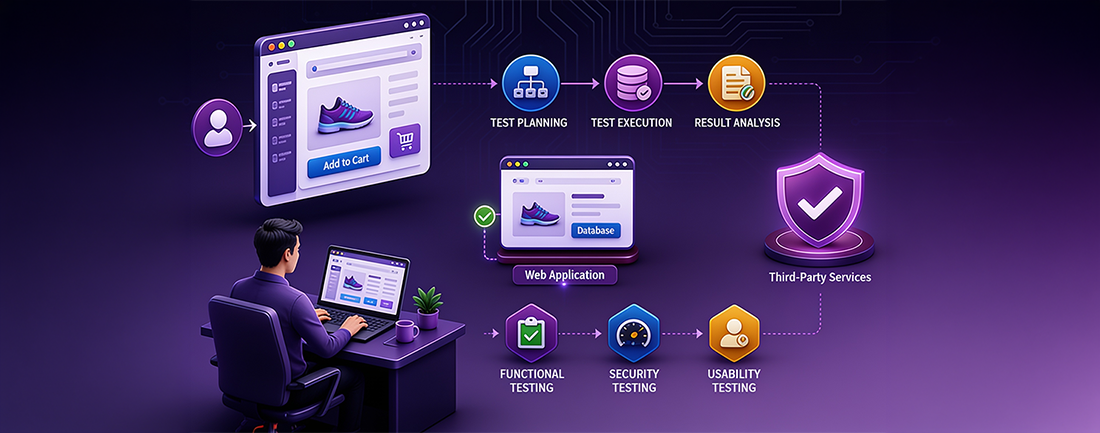
End-to-End Testing is crucial in software development to ensure a robust application. Here's a brief technical overview of key strategies and approaches.
1. Top-Down and Bottom-Up Testing
Top-Down Testing Approach:
- Design the main module first and call submodules. This approach provides an overview of the entire application's functionality.
Bottom-Up Testing Approach:
- Create different modules independently, and then integrate them into the main module. This method helps identify and resolve issues at the module level.
2. Risk-Based Testing Strategy
Prioritize testing based on the probability of risks. Assess software complexity, critical business aspects, and potential defect-prone areas.
Risks can be:
Positive (Opportunities): Investing in new projects, and changing business processes.
Negative (Threats): Issues that may impact cost, business, and technical aspects.
3. Approaches to End-to-End Testing
1. Sequential Testing: Tests are executed one after another in a predefined sequence. Uses optional stopping rules to maintain error rates. Provides improved efficiency and flexibility but requires careful statistical modeling.
2. Parallel Testing: Executes tests simultaneously in multiple environments, devices, and browsers. Reduces testing time significantly.
3. Great for compatibility testing. Ideal for continuous integration and delivery (CI/CD) processes.
4. Agile and Continuous Testing Approaches: Integrates testing throughout the software development lifecycle. Agile emphasizes iterative testing in short cycles (sprints). Continuous testing ensures testing aligns with ongoing development for quick feedback and release cycles.
5. Implementing Parallel Testing: Choose the right automation framework (e.g., FireFlink). Establish entry and exit criteria for parallel testing. Leverage cloud-based solutions for scalability. Run tests concurrently in multiple environments.
6. Benefits of Parallel Testing: Reduces test execution time. Reduces testing costs. Increases test coverage across devices and browsers. Optimizes CI/CD processes for quick feedback. Improves overall testing practices.
7. Challenges and Best Practices: Address complex dependencies and flaky tests. Manage resources effectively. Prioritize test cases for efficiency. Ensure independent and atomic test scripts.
Conclusion:
End-to-End Testing is essential for delivering reliable software. Whether adopting top-down, bottom-up, or risk-based approaches, understanding the nuances of sequential and parallel testing is key. Embracing agile and continuous testing ensures adaptability in today's fast-paced development landscape. By navigating these strategies, development teams can enhance efficiency, reduce risks, and deliver high-quality applications.