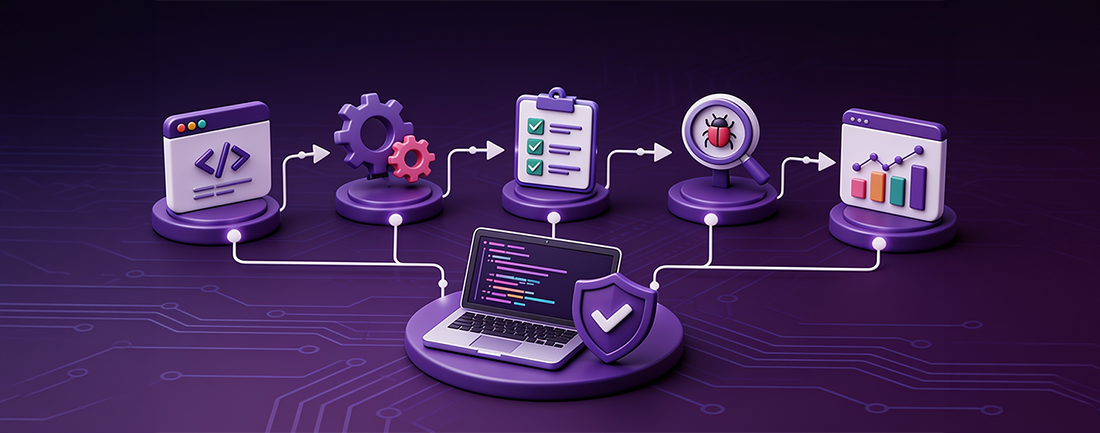
What is End to End(E2E) Testing?
End-to-end (E2E) testing is a technique that ensures an application functions as intended from start to finish. Key aspects include:
- Tests the application in a way that a real user would use it.
- Involves testing the application's front end, back end, databases, and all integrations.
- Verifies that data remains consistent and accurate throughout the workflow.
- Identifies any issues arising from system interactions and integrations.
- Acts as the last line of defence to catch any undiscovered bugs before release.
Why do we need E2E Testing Tools?
End-to-end (E2E) testing is crucial for verifying the correct functionality of an application from the end user's perspective. Automating this process with E2E testing tools enhances efficiency and reliability. Here's why E2E testing tools are indispensable:
-
Comprehensive Coverage: They allow for the testing of the entire application flow, including front-end, back-end, and integrations, ensuring all parts work seamlessly together.
-
Early Detection of Defects: E2E testing identifies issues that might be overlooked by unit or integration testing, enabling early resolution in the development cycle.
-
Reliability Assurance: It helps confirm consistent application performance across various environments and platforms, enhancing the user experience.
-
Efficiency through Automation: Automating E2E tests saves significant time and effort compared to manual testing, enabling more frequent testing cycles.
-
Regression Testing: E2E tests are pivotal for regression testing, ensuring that recent changes haven't adversely affected existing functionalities.
-
Integration Verification: They confirm that external service integrations, like APIs or databases, are functioning correctly within the application ecosystem.
-
Code Quality Improvement: By catching errors early and ensuring functional integrity, E2E testing tools play a key role in enhancing the quality of the codebase.
Expectations from E2E testing tools include:
-
Ease of Use: The tools must be straightforward to set up and operate, enabling developers to efficiently create tests.
-
Reliability: They should consistently deliver precise results and effectively identify errors.
-
Scalability: The tools need to accommodate the growing complexity and size of applications, facilitating tests at any scale.
-
CI/CD Integration: Seamless incorporation into the CI/CD process is crucial for automating and consistently executing tests.
-
Detailed Reporting: Tools should provide comprehensive reports and logs for quick issue identification and resolution.
-
Robust Support: Comprehensive documentation and support are essential for swiftly addressing any arising issues or questions.
Best Tools of E2E testing:
1. FireFlink: Among the array of tools available, FireFlink stands out as a leading solution for E2E testing, offering a plethora of features that cater to a wide range of testing requirements without the need for extensive programming knowledge. Here's why FireFlink is considered among the best tools for E2E testing:
-
User-Friendly Scriptless Automation: FireFlink provides a scriptless automation platform that is easy to use, making it accessible for testers with limited or no programming background. This approach facilitates the rapid creation of E2E scripts, enhancing productivity and efficiency in the testing process.
-
Comprehensive Testing in One Script: It allows for the automation of web, mobile (iOS/Android), desktop, database, and API testing within a single script. This unified approach significantly simplifies the testing process, saving time and reducing the complexity of managing multiple testing scripts.
-
High Automation Capacity: Users can automate between 20-25 E2E scripts daily, and with the integration of QA and AI technologies, it's possible to automate up to 500 tests across different platforms in just 10 days. This capability demonstrates FireFlink's exceptional efficiency and speed in test automation.
-
Advanced Features Without Coding: Automating tests for OTPs, texts, images, and captchas is straightforward with FireFlink, as it eliminates the need for writing complex programming code. This feature broadens the scope of test automation, encompassing elements that are typically challenging to automate.
-
Integrated Defect Tracking: The built-in defect tracking functionality enhances the workflow by removing the dependency on external tools for issue tracking. This integration streamlines the identification and resolution of defects, improving the overall quality of the software.
-
Supports Manual Test Case Management: Beyond automation, FireFlink also caters to manual test case management. This feature ensures that teams can manage all their testing needs within a single platform, further consolidating testing efforts and documentation.
-
Comprehensive Execution Reports: FireFlink generates detailed execution reports that provide a thorough overview of the testing process and outcomes. These reports are invaluable for analyzing the performance and effectiveness of the tests, offering insights that can guide future testing strategies.
In conclusion, FireFlink emerges as a versatile and powerful tool for E2E testing, encapsulating a wide range of functionalities in a scriptless, user-friendly platform. Its capacity to automate complex tests across various platforms without the need for coding makes it a standout choice for teams aiming to enhance their testing efficiency and software quality.
2. Cypress Overview:
-
A modern tool designed for a rapid and reliable testing experience of web applications.
-
Offers a unique testing experience with real-time testing capabilities and easy test writing.
-
Strong in the latter stages of development but less effective for functional testing, making it a somewhat limited tool for end-to-end (E2E) testing.
Key Features:
-
Architecture: Runs directly in the browser, providing close control over the application under test for faster and more reliable tests.
-
Automatic Waiting: Eliminates the need for manual waits by automatically waiting for elements to appear on the page, enhancing test reliability.
-
Time Travel: Enables viewing the application at any test execution point, aiding in precise debugging by identifying when and where issues occur.
-
Real-time Reloads: Offers real-time feedback on test changes, improving the development process through immediate visibility of changes' impact.
-
Cross-browser Testing: Primarily supports Chrome but also offers experimental support for Firefox and Edge, expanding testing capabilities.
-
Dashboard Service: Provides a platform for recording and storing test results, and supports running tests in parallel across multiple machines for enhanced testing efficiency.
3. Selenium: Primarily recognized as a leading tool for end-to-end (E2E) testing, Supports a multitude of programming languages and browser types, making it ideal for web application testing. It comprises a collection of tools and libraries tailored for automated browser testing. Selenium WebDriver, a component of the Selenium suite, is commonly referenced when discussing E2E testing with Selenium.
Versatility: Supports various programming languages and browsers.
Selenium WebDriver: Key component for E2E web application testing.
4. Appium: As an open-source automation tool, extends its capabilities to mobile applications on Android, iOS, and Windows platforms. Leveraging the WebDriver protocol, it facilitates E2E testing of mobile apps, offering adaptability across various devices and platforms.
Open-Source:Freely available for mobile app automation.
Cross-Platform:Supports Android, iOS, and Windows.
WebDriver Protocol: Utilises standard protocol for E2E mobile app testing.
5. Appium: As an open-source automation tool, extends capabilities to mobile applications on Android, iOS, and Windows platforms. Leveraging the WebDriver protocol, it facilitates E2E testing of mobile apps, offering adaptability across various devices and platforms. Open-Source:Freely available for mobile app automation. Cross-Platform:Supports Android, iOS, and Windows. WebDriver Protocol: Utilises standard protocol for E2E mobile app testing.
6. TestCafe: This E2E testing framework for web applications can execute tests concurrently across multiple browsers. It simplifies test scripting with an easy-to-use API and operates without the need for WebDriver or browser plugins, simulating user interactions to validate web application behaviours.
Parallel Testing: Executes tests across various browsers simultaneously.
Simple API: Facilitates easy test scripting.
No WebDriver Required: Operates independently of WebDriver and browser plugins.
7. Katalon Studio: A comprehensive automation tool, Katalon Studio supports E2E testing across web, mobile, and API applications. It features a visual test recorder and scripting capabilities in multiple languages, offering a suite of functionalities including cross-platform testing and CI/CD integration.
Versatile Testing: Covers web, mobile, and API applications.
Visual Test Recorder: Simplifies test creation.
Cross-Platform Support: Enables testing across different platforms and environments.
8. Puppeteer: Developed by Google, this Node.js library offers a sophisticated API for controlling headless Chrome or Chromium browsers. While not a standalone E2E testing framework, Puppeteer is pivotal for crafting E2E tests for web applications, including actions like navigation, form submissions, and media capture.
Google Development: Offers advanced browser control.
Headless Chrome Control: Automates browser actions without a GUI.
Foundational Tool: Basis for building comprehensive E2E web application tests.
9. Detox: Engineered by Wix, Detox melds white box and black box testing techniques for mobile app testing. Designed to mimic user behaviour on real devices or simulators, it boasts features such as automation synchronisation and fast test execution.
Hybrid Testing Approach: Combines white box and black box methodologies.
User Interaction Simulation: Tests mobile app behavior on real devices or simulators.
Feature-Rich: Includes automation synchronization and fast execution capabilities.
10. Playwright: A modern tool providing cross-browser testing features akin to Selenium but with an updated API. It supports various programming languages and excels in documentation, offering capabilities like automatic waiting and CI/CD tool integration.
Cross-Browser Testing: Compatible with multiple browsers.
Comprehensive Language Support: Facilitates use across different programming environments.
11. Testrigor: Fully hosted in the cloud, Testrigor enables the creation of intricate test automations with a no-code approach, ideal for manual and hybrid QA testers seeking streamlined test execution processes.
Cloud-Hosted: Offers a fully online testing environment.
No-Code Automation: Simplifies test creation for QA testers.
Complex Test Execution: Allows for detailed and intricate testing scenarios.
12. HeadSpin: By simplifying E2E testing, HeadSpin ensures the delivery of quality web, mobile, video, and audio experiences throughout the app development lifecycle, focusing on performance and user satisfaction.
Simplified E2E Testing: Reduces complexity in testing.
Comprehensive Quality Assurance: Covers web, mobile, and multimedia applications.
Lifecycle Coverage: Supports testing from development to deployment.
13. Tosca: Developed by Tricentis, Tosca streamlines the automation of end-to-end functional testing for web, desktop, mobile, and API applications. Utilizing a model-based testing approach, it enables the creation of test cases through graphical modeling of the application under test, providing a holistic test automation solution.
Tricentis Development: A leading tool in software testing automation.
Model-Based Testing: Facilitates graphical representation of test cases.
Comprehensive Suite: Offers extensive testing solutions across multiple In conclusion, the array of end-to-end (E2E) testing tools available today equips modern software development and testing practices with the ability to thoroughly assess applications in scenarios that closely mirror real-world user experiences, including network communication and database interactions. This rigorous form of testing bolsters confidence in the application's quality and contributes significantly to delivering an enhanced user experience.
Traditionally dominated by manual execution due to the prohibitive costs of automation, E2E testing serves not only to validate entire systems but also proves invaluable in examining the integrity of external integrations. However, the manual approach, while comprehensive, often extends testing timelines and introduces a margin for error inherent to human involvement.
In response to these challenges, solutions like FireFlink emerge as a transformative option, offering a streamlined avenue towards automation with minimal or no coding required. FireFlink presents itself as an all-encompassing solution for automation needs, enabling more accurate, efficient, and cost-effective testing processes. By leveraging such advanced tools, organisations can significantly curtail testing durations while ensuring the delivery of high-quality, robust applications, thereby fostering a superior end-user experience.