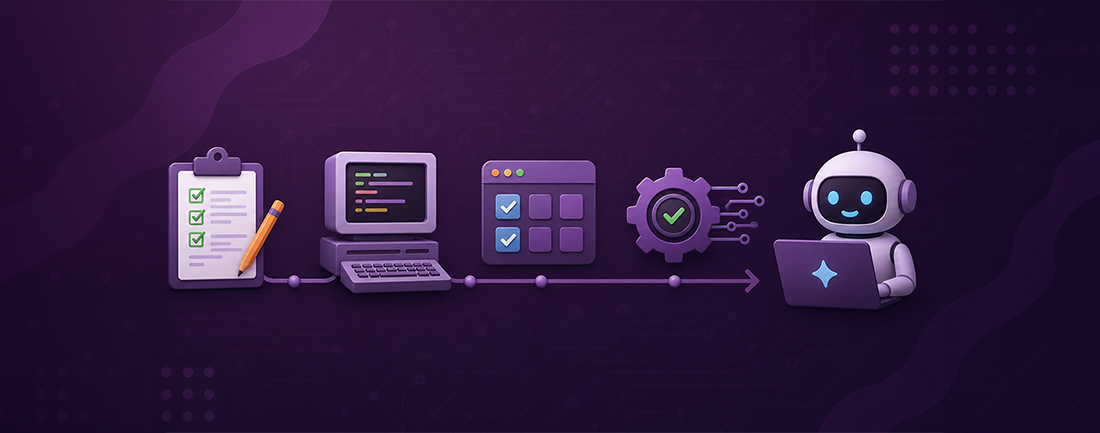
A story of craftsmanship, code, and AI — for every technology professional.
Every Great Product Has a Guardian
Imagine you have just built something extraordinary — a sleek mobile app, a mission-critical enterprise platform, or a delightful e-commerce experience. You are proud of it. Your team has poured weeks of effort into it. But before it reaches your users, one question looms large:
"How do you know it actually works?"
That question is the heart of software testing — and the answer has transformed dramatically over the past five decades. This is the story of that transformation.
Chapter 1: The Age of the Clipboard (1950s–1980s)
Manual Testing — Where It All Began
Picture the 1960s. A programmer finishes writing code on punched cards. Somewhere in the building, a dedicated team of testers — often called 'checkers' — sits at terminals with thick printouts, a clipboard, and an eye for inconsistency. Their job? Read the output. Compare it to expected behavior. Write it down. Repeat.
This was manual testing in its purest form—human eyes, human judgment, and human patience. And for the software of that era, it was perfectly sufficient. Programs were short. Requirements were simple. A tester could hold the entire system in their head.
"Testing shows the presence of bugs, not their absence." — Edsger W. Dijkstra, 1969
As software complexity grew through the 1970s and 1980s, so did the discipline. Structured methodologies emerged. Glenford Myers published The Art of Software Testing in 1979 — a landmark text that formalized concepts like boundary value analysis, equivalence partitioning, and test case design. Testing was no longer ad hoc; it was becoming a craft.
What manual testing gave us:
· Deep exploratory insight — humans notice what machines cannot anticipate · Usability awareness — testers experience the product as users do · Flexibility — no setup needed; adapt instantly to any change · Slow and labor-intensive at scale · Inconsistent — human fatigue leads to missed defects · Not repeatable — the same test, run twice, might yield different coverage
Chapter 2: Entry of the Robots (1990s–2000s)
Traditional Test Automation — Precision at Speed
The 1990s changed everything. GUIs exploded. Client-server architectures multiplied. The World Wide Web arrived. And with it came a terrifying realization: you cannot manually test a thousand user journeys across five browsers every time you deploy new code.
Automation was the answer. Tools like Mercury WinRunner (1993), Rational Robot, and later Selenium (2004) allowed testers to record and replay interactions. Scripts replaced clipboards. CI pipelines began to take shape.
The philosophy was elegant: write a test once, run it a million times. Regression suites became the safety net for engineering teams. The Test Pyramid — a concept popularized by Mike Cohn — taught us to invest heavily in fast unit tests, complement them with integration tests, and cap the suite with a smaller set of end-to-end tests.
"Automate everything you can, and test what you must manually." — The guiding principle of the QA engineer in the 2000s
Key milestones in traditional automation: · 1994 — JUnit framework (Java) democratizes unit testing · 2004 — Selenium WebDriver opens the door for browser automation · 2006 — Continuous Integration with Jenkins starts normalizing automated build-test pipelines · 2009 — Cucumber & BDD (Behavior-Driven Development) make tests readable by business stakeholders · 2011 — Appium brings mobile test automation into the mainstream
Yet even with automation, problems persisted. Tests were brittle — one UI change broke hundreds of scripts. Maintenance overhead was enormous. Coverage remained incomplete. And the most creative, exploratory testing still required a skilled human. The robots were fast, but they lacked imagination.
Chapter 3: The Intelligence Arrives (2010s–Early 2020s)
AI-Assisted Testing — Smart, Self-Healing, and Scalable
The 2010s brought a new kind of disruption: machine learning. Suddenly, computers could learn patterns. And testing — a domain rich with patterns — was an obvious candidate for intelligence.
First-generation AI testing tools focused on practical pain points. Applitools pioneered Visual AI — comparing screenshots pixel by pixel, but smart enough to ignore irrelevant differences like font rendering. Testim introduced self-healing tests that automatically adapted when UI elements moved. Mabl and Functionize used ML to identify which tests were most likely to catch bugs given recent code changes.
In parallel, shift-left testing redefined when testing happened. Rather than catching bugs after development, teams began embedding QA into every sprint, every pull request, every commit. DevOps and CI/CD matured. Testing was no longer a gate — it was a continuous pulse.
"Quality is not an act, it is a habit." — Aristotle (adopted by every DevOps team ever)
This era gave us faster feedback loops, smarter regression prioritization, and the first glimpse of testing that could anticipate problems rather than simply react to them.
Chapter 4: The Copilot Era (2022–Present)
Generative AI in Testing — From Automating Tasks to Augmenting Thinking
In 2022, something shifted. Large Language Models (LLMs)—such as GPT-4, Claude, and Gemini—demonstrated an extraordinary capability: understanding context, generating coherent code, and reasoning about software behavior using natural language. The implications for testing were profound.
We entered the era of GenAI-powered testing — and it is unlike anything that came before.
What GenAI Changes About Testing
1. Automatic Test Case Generation
Give a GenAI model a user story, a function signature, or an API spec — and it generates comprehensive test cases in seconds. Not just happy-path tests, but edge cases, negative scenarios, boundary conditions. Tools like GitHub Copilot, CodiumAI, and Diffblue Cover do this today.
2. Natural Language to Test Code
A product manager writes: 'When a user logs in with wrong credentials three times, they should be locked out.' A GenAI testing tool converts that directly into executable test code — no manual translation needed. The gap between requirements and tests collapses.
3. Intelligent Bug Detection & Root Cause Analysis
GenAI models trained on codebases and bug reports can predict where defects are likely to appear — before tests are even run. When failures occur, they analyze logs, stack traces, and code diffs to suggest probable root causes instantly.
4. Self-Healing and Autonomous Test Maintenance
When the UI changes, traditional tests break. GenAI-powered tools understand the intent of a test and autonomously rewrite the locators and assertions to match the new structure. Maintenance overhead — historically the Achilles heel of automation — shrinks dramatically.
5. Conversational Test Design
Engineers can now have a dialogue with their test suite. 'Show me all tests covering the payment flow.' 'Generate a test for this new API endpoint.' 'What scenarios am I missing?' Testing becomes interactive, accessible, and collaborative.
6. Intelligent Test Data Generation
GenAI synthesizes realistic, diverse, privacy-safe test data at scale — something that was previously a major bottleneck in testing regulated industries like healthcare and finance.
"The question is no longer whether AI will change testing. The question is how fast your team will adapt." — Forrester Research, 2024
The Evolution at a Glance
Software testing has evolved significantly across dimensions over time. In the manual testing era (1950s–1990s), testing was slow, limited by human capability, and relied heavily on creativity and empathy, with no defined maintenance overhead. Moving into the traditional automation phase (1990s–2010s), testing became faster—especially for regression—with script-defined coverage, but introduced high maintenance due to brittle tests, while emphasizing repeatability as its core strength.
With the rise of AI-assisted testing (2015–2022), testing became faster and smarter, leveraging ML-prioritized coverage and self-healing capabilities, bringing predictive insight into the process. Today, in the GenAI testing era (2022–present), testing operates at near-instant speed and scale, with AI-generated coverage, autonomous adaptation, and a powerful combination of natural language understanding and code generation redefining how quality is achieved.
Where Are We Headed?
The trajectory is clear: testing is evolving from a verification activity into an intelligent, proactive quality system. Here is what the near future holds:
Agentic Testing Systems: AI agents that autonomously explore applications, identify risk areas, write tests, run them, and file bugs — all without human prompting. Think of it as a QA engineer that never sleeps.
Shift-Everywhere Testing: Quality embedded at every layer — from design prototypes to production monitoring — with AI connecting the dots across the entire software lifecycle.
Continuous Quality Intelligence: Real-time dashboards powered by AI that predict production failures based on test signals, code complexity, and historical defect patterns.
Democratized Testing: Non-engineers — business analysts, product managers, domain experts — writing and validating tests in plain English, with AI translating their intent into executable code.
A Reflection for Every Tech Professional
Whether you are a developer, a QA engineer, a product manager, or a CTO — this evolution matters to you. It is not just about tools changing. It is about the philosophy of quality itself deepening.
Manual testing taught us empathy — the discipline of thinking like a user. Automation taught us discipline — the habit of repeatability and consistency. AI is now teaching us something new: anticipation — the ability to foresee problems before they manifest.
The best teams of the next decade will not choose between human judgment and artificial intelligence. They will orchestrate both — using AI to handle the scale, speed, and breadth, while humans focus on creativity, strategy, and the user experience that no algorithm can fully replicate.
"The goal of software testing is not to find bugs. It is to build confidence — confidence that the software does what it should, when it should, for everyone it should."
What's Your Testing Story?
We'd love to hear from you:
• Are you still in the manual testing era, building strong foundations?
• Have you scaled with automation and now fighting the maintenance battle?
• Are you experimenting with GenAI tools in your QA workflow?
Here Comes FireFlink—an AI-powered, scriptless automation platform that brings together Agentic AI, Prompt-to-Test Automation, NLP Test Authoring, AI Test Script Recorder, FireFlink Finder, AutoMark, AI-powered analytics, unified test automation, and intelligent end-to-end testing in a single platform. FireFlink empowers teams to accelerate automation, improve software quality, and confidently embrace the future of AI-driven testing.
Reach out to our team. Let us shape the future of quality engineering — together.